A Different Theater: Not the Text but the Stage
Nicolas Doutey’s book, Une idée de scène. Avec l’écriture théâtrale de Beckett (Classiques Garnier, Paris 2025), is the result of a doctorate at the Sorbonne in Paris in which the author combines dramaturgical analysis (on Beckett) and stage practice, thus discovering his own vocation not for the University but rather for the work of playwright and Dramaturg. Beckett breaks with traditional theater, founded on the centrality of character, rich in psychology, and moves under the sign of subtraction. The starting point often consists of a realistic dimension and a historical-social context that gradually disappears. For example, in Waiting for Godot Estragon and Vladimir are originally two Jews waiting for contact with a person tasked with bringing them to safety, whose code name is perhaps Godot: an implicit reference to Beckett’s involvement in the French Resistance under Nazi occupation. The final version is instead the metaphysical epiphany of two creatures who await the end of life, encountering Pozzo and Lucky twice, who, at the second encounter (which is the following day), have become blind and mute respectively. No more realism and not even characters, reduced to mere symbolic figures. The waiting for the end is woven with progressive impairments, in a framework of gradual spatial constriction. If here there is still an opening of horizons, in other texts the performers are inhibited in their movements, immobilized, buried (first up to the waist, then only with the face emerging above the ground), or immersed in garbage bins. A theater that expresses the sense of life as the unstoppable decay of the body, up to the loss of speech, to the silence that anticipates eternal silence (some very brief texts are titled Acts Without Words, a long stage direction without dialogue).
Doutey’s is a militant book, in the spirit of the times, which will certainly interest today’s restless intellectual youth: it pursues another idea of the stage, inspired by pragmatist philosophy, opposed to the text-centric vision of theatrical tradition. According to which, in primis there is writing, and only secondarily does the stage come into play. Doutey insists on the concept of incarnation, which obviously suggests a religious inflection. Certainly, there has been talk of the magic of the stage, a space of transformation and transcendence, where the actor’s body, incarnating the character, makes real what is imaginary. Doutey rejects this conception, albeit at the cost of a convenient extremization (“for there to be true incarnation, a miracle is needed, one must cross the boundary between life and death”), that is, not accepting to understand the miracle in merely metaphorical terms.
For Doutey, Beckett’s theater is splendidly functional: there are no longer characters in which it is possible to incarnate oneself, but only shadows of figures, mutilated and sometimes mute, which by contrast exalt the protagonist centrality of the stage, each time differently invented. Beckett—Doutey concludes—resists the idea of incarnation, which is “an unavoidable pillar of the dominant conception of theatrical fact from which the contrast between text and stage derives.”
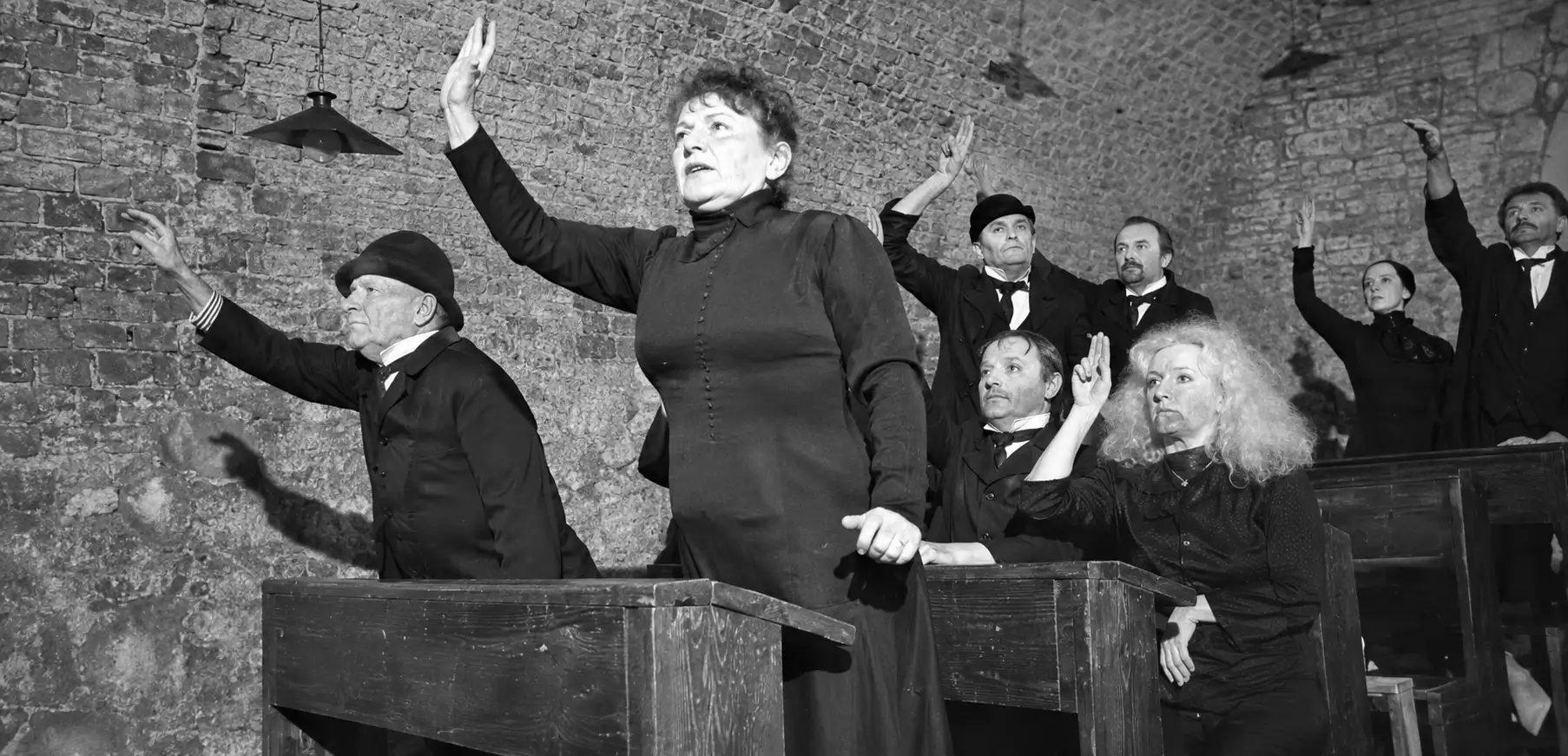
And yet an alternative idea of the stage, not complementary to a text in a position of primacy, is quite possible; a theater that does not represent, that is, that does not re-present something that is supposed to be already presented in another space (that of the book or the simple script), but is the theater of Kantor, of Grotowski, of Barba and a few others, which we saw at the end of the twentieth century. In Kantor’s The Dead Class the only true character is the stage device, five rows of old school desks, on which sit (seated, standing, moving…) a dozen old people, reawakened to the memories of their lives by the sound of a beguiling waltz. Not an authorial writing to be translated onto the stage, but rather a stage writing of which the director is the author. There is no need, in short, to declare wars of extermination, if coexistence is possible between two different theatrical practices. The only problem is that this is a theater in need of a rare commodity, of poets of the stage, not yet perceived in this first segment of the new century… Whereas the text-centric traditional theater, with its millennial heritage of pièces, guarantees at least what certified pre-owned does…
(published in “Italypost”, May 17, 2026)


